All Things Baby Sleep
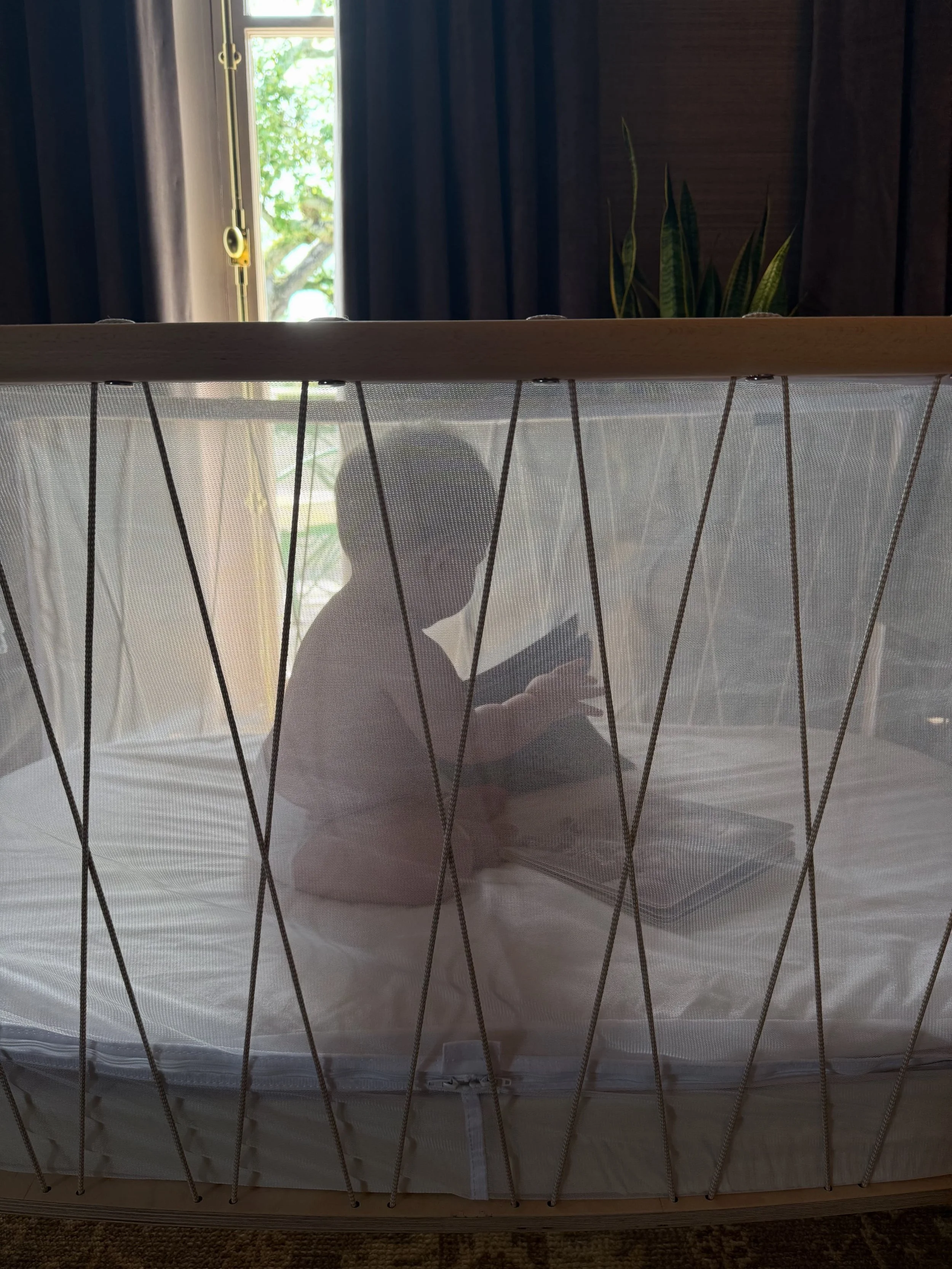
To every parent feeling lost and frustrated when it comes to baby sleep, I see you. I was lost too in the beginning of my own postpartum journey.
I want to give some general advice that would have helped me during a very overwhelming time and share some things I’ve learned from Drs. Greer Kirshenbaum and Rocio Zunini’s nurture neuroscience course that I’ve been part of for much of the year now. This information is very high in nurture and applicable for wanting to raise a securely attached and content baby with healthy brain development.
Before we dive in, it helps to understand that baby brains are different from adult brains, and because of this, baby sleep looks different from adult sleep. Training a baby to sleep like an adult is not supportive of healthy brain architecture, mental health, or physical health.
Why Baby Sleep Looks Different
Neuroscience shows that when babies sleep alone they excrete cortisol, the stress hormone, while sleeping. One of the best things to know is that when you nurture your baby’s sleep through contact napping and co-sleeping, their brains will not secrete cortisol during sleep. They will get more quality sleep required for development and learning as opposed to when sleeping alone and releasing cortisol into their system (essentially stressed while sleeping).
When babies learn that you will stop responding to them, they will stop calling out (that is sleep training). Your baby spends more time in healthy REM sleep, developing the billions of neural networks required for growing a healthy brain when cosleeping.
Babies are born with only 25 percent of their adult brain volume and cannot self-soothe; they can only disassociate to protect their developing nervous systems. Babies do not develop their prefrontal cortex, required for reasoning, until around age three.
Through nurture (responsive eye contact, engagement, touch, feeding, and sleep) you directly help their neural connections, up to 1 million synapses per second, form in the first three years of life. Babies spend 50 percent of the first three years of their life asleep. As you can see, this is why the quality of sleep that babies receive is just as important as the time you spend with them while they are awake.
Building Healthy Sleep Foundations
The name of the game for healthy baby sleep is patience. There is no quick fix, and anything that promises a quick and easy fix is generally not a good long-term solution. Convenience for parents does not often translate to long-term health for baby.
The good news is that if you foster a healthy sleeping environment early on, it will make for secure sleepers in the near future with many other life-long benefits.
Every baby is born with different genetics and nervous system temperaments. The type of pregnancy and birth that you have can also play a part in the sensitivity of a baby’s nervous system. The great thing is that you can rewire your baby’s stress system with a high-nurture environment.
Some babies are easily put down to sleep; others are orchid babies and require lots of soothing to fall asleep. My baby is an orchid and a koala baby (sensitive and always wanting to be held). It is not a one-size-fits-all approach.
Getting to know your baby’s specific needs takes time and effort over the course of months. Babies who are often sleep trained are usually the ones who needed a high-nurturing environment for sleep, which is so sad because, conversely, their needs are unmet.
Neuroscience shows that male babies are more sensitive to having a high-nurturing environment due to testosterone, yet society tends to be less coddling to baby boys than to girls because they don’t understand this. No matter the temperament of your baby, you can never spoil them with love and care.
The Science of Staying Close
It’s best for babies to be in the same room as their primary caregivers for the first six months of life during naps and, at the minimum, for the first year of life for nighttime sleep. The longer your baby sleeps with you, the more secure the attachment and the more connections and neural networks the baby builds in their brain.
Babies rely on your quality of care for their quality of growth. The brain is in infancy until three years of age. Expect your baby to have night wakings until at least the age of three, and welcome them into your loving arms whenever they need it most, even if they are sleeping in their own bed or room at that point.
Mirror neurons (where the baby emulates those of an adult’s neurons while in close proximity to an adult) help the baby regulate their heart rate and breathing and support physiological regulation, which is associated with lower SIDS risk.
There are important biological reasons why humans have kept their babies close at night since the very beginning of time. Attempting to force independent sleep for babies is a relatively new way of existing and mostly seen in Western countries and cultures.
If you are breastfeeding, the ideal time to night-wean is 18 months. There are many nurturing ideas and ways on how to prepare babies for weaning and transitioning them into a new bed.
Feed Your Baby to Sleep
Feed your baby to sleep! You have the most beautiful tool that babies respond so well to—milk. Sucking releases serotonin. Breastfeeding releases oxytocin and contains melatonin at night. These are natural ways of relaxing your baby (and you) into sleep. They will not become dependent into childhood on milk before bed, nor will they get cavities from feeding to sleep.
It is a myth that you need to separate feeding from sleep—it just makes it harder for parents to get their babies to sleep.
Give yourself permission to follow your intuition and use what makes biological sense to parent. Modern parenthood struggles can often be made easier by not resisting babies’ natural need for dependence.
Doing all of these things to try and create barriers and force independence is something that makes it more difficult than it’s supposed to be. Give yourself a break (and permission), and let go!
Finding Rhythm in Daytime Sleep
Naps in the baby carrier, car seat, stroller, and while being held are all great. Putting in the effort to rock, sway, and bounce your baby to sleep are all normal ways for a baby to get into a relaxed state and drift off.
Naps during the day in the sunlight (or blinds open) are good for babies’ circadian rhythm. Naps can range from 20 minutes to 2.5 hours long! Everything depends on the day and time. Babies require enough sleep pressure built up, combined with relaxation, to fall asleep. Each day will look different, so strict schedules really don’t make sense.
The Role of Sensory Play
Make sure your baby is spending lots of time doing different sensory activities throughout the day. Stroller rides are not considered a sensory activity.
Moving around on the floor, in the grass, in water, and feeling different textures are what babies need to be truly stimulated. These sensory experiences help integrate the nervous system, leading to deeper, more restorative sleep.
It’s best to take your baby outside as soon as they wake up in the morning so that they’re exposed to sunlight to regulate their circadian rhythm.
Letting Go of Control
Parents make it so hard on themselves by trying to stick to rigid schedules or forcing their baby to sleep for a certain amount of time. I encourage you to let go of trying to control exactly when and the amount of time your baby sleeps.
When supported, babies will sleep for as long or as short as their brain requires, and they will connect sleep cycles when it’s developmentally appropriate for them. Once you find their rhythm, they will also create their own schedules.
Babies have innate wisdom, and we don’t need to teach them how to sleep we just need to support them getting there.
Contact Naps and Bodywork
Contact naps are a game changer for babies who are not comfortable with being put down. Evolutionarily, contact naps have always supported babies’ brains and have been convenient when baby-wearing while getting things done around the house.
If your baby doesn’t like being in a carrier, it’s often a sign that there is some tension that needs to be addressed through bodywork like cranial sacral therapy, which is simultaneously amazing for calming the nervous system. I have seen incredible results from bodywork that addresses sleep issues, getting the latch right for breastfeeding, colic, and gas. Just as adults benefit from massages or therapies, babies do too.
You can also hold your baby during naps or lie down in bed with them. Get a good book to read while you’re nap trapped. Some babies will allow a transfer to a crib once in a deep sleep. However, it’s best to sleep when the baby sleeps!
You might wonder how you are supposed to get anything else done around the house if you’re sleeping when the baby sleeps, and this is where forming a village comes in.
Creating a Village
It’s crucial to set up a village during the first year of parenthood. Before having your baby, get your village together to set yourself up for success. That may look like having your parents, siblings, a mother’s helper, nanny, friends, postpartum doula, or housekeeper—whatever avenue of help you can get, take it.
Raising a baby was not meant to be done as a solo job, and it’s often a big cause today of postpartum depression.
If you look back in time through an anthropological lens, you will see that throughout history babies had multiple secure attachments and were not meant to be alone in a nuclear family with only the parents caring for them. It’s not fair for babies to have their needs neglected simply because we are alone with them more than we can handle.
The witching hour occurs when a baby is chronically overtired. Once you figure out how to help them sleep throughout the day (most likely lots of singing, rocking, and bouncing followed by contact napping) they will be much more content and not have these stressful episodes.
It feels so good to let go of all the rules and structure that you might be inflicting on yourself as a parent and to really relax into a rhythm that’s biologically sound for both you and your baby.
Understanding Developmental Shifts
When babies reach month four, they begin having an awareness of caregiver-to-baby proximity. This is often mislabeled as the “four-month regression,” but it’s actually a progression and big developmental period for the brain.
This is generally when orchid and koala babies that I mentioned don’t want to be separated for naps or nighttime sleep. You might wonder, “Why doesn’t my baby want to be alone when sleeping now? They seemed okay alone before.”Neuroscience can tell you why. I’m happy to share what we’ve done and how beautifully it’s worked out.
If you are co-sleeping or bedsharing and looking to roll away from your baby and get some time to yourself during naps and at night, it’s best to do this during the first nap of the day and the first hour or two of sleep at nighttime. This can often be successfully done between 8–10 months of age. We are currently at this stage, and it’s working out very well!
It may take 20–30 minutes of effort (bouncing and/or walking with them) to get your baby to sleep, and that is totally normal! You will build great muscles. If you need extra help, this is where a partner, parent, doula, or nanny can step in and do some bouncing and swaying. Offer the nap, do not force it.
That goes for bedtime too. What I mean by that is if you try for 20–30 minutes and your baby is not wanting to go to sleep, try again in an hour. Remember that this is just a short season of life, and it will fly by.
If your baby wakes up several times per night to eat, that is very appropriate for a long time and even after the first year of life, especially if you have not night-weaned as a breastfeeding mother. If your baby wakes at night to eat, let them! Babies go through cluster feeding phases during different developmental growth spurts and sometimes get more of their calories in during the nighttime, especially if they are very active during the day.
The Emotional Work of Nurtured Sleep
You might wonder what to do for these months in between when you feel like you can’t leave your baby alone. Enjoy it!
There won’t be another time in your life with this little one where you get to soak in all of these amazing cuddles. You are actively working by contributing to building your baby’s brain. There is no work more important than that.
Once you accept your role here, rather than trying to resist and live in a structured way of what you think you want or need to do, everything else melts into place so harmoniously.
I consider it a privilege every night to put my baby to sleep. I hold him close to me for all the mothers who can’t hold their own babies.
Parents go through tremendous brain changes postpartum, and when we nurture sleep for our babies, we are also rewiring our own brains. This is a period that only lasts for a short time. Take advantage of the benefits for your own brain health while you can.
There will be difficult stages, but remember that these are sleep progressions (often referred to as regressions), which are times when your baby is making developmental leaps and bounds. It’s similar to studying for a test in school— babies practice these skills in their subconscious while they sleep.
Who said being a parent is easy or convenient? It is a beautiful and highly rewarding thing despite the trials and tribulations.
When You Need Support
If you have to go back to work and are looking at daycare or a nanny (or even if you are looking to bring in a nanny for extra help at home), there are nurturing ways to best support your baby so that your baby can feel secure in their attachments. We have thrived the most in our household when there have been three of us to care for our baby.
If you’re working full-time and feel like you need to get more sleep at night, try going to bed when your baby goes to bed. You will often get enough sleep for the following day. There are lots of creative ways to make it work so that you and your baby both benefit from this sacred time.
If you are a stay-at-home mom, you are doing so much work every hour engaging with your baby and contributing to building their healthy brain. Fall into a sleep rhythm with them, and really relish this precious time.
The Importance of Secure Attachment
When babies are in the womb, they receive everything they need, and it’s our job as parents to meet all of their needs when they are born. It is their human right.
The more you respond to your baby when they cry, the more securely attached they will become, and the less anxiety and behavioral problems you’ll see as they grow.
Greet your baby as soon as they wake. Respond to every cry. Hold them whenever they need holding. A content baby is one with all of his needs met.
I always ask: what would you do if someone was looking at you and saying, “Please help me, I feel so unsafe and uncomfortable”? Would you ignore them? This is what your baby is trying to communicate when they are crying to go to sleep. They are communicating a need, and it’s our job as parents to fulfill that.
Looking at sleep through the lens of a baby changes everything you may be trying to resist into an enjoyable and peaceful time in your life.
Love Changes Everything
I believe so much in nurturing babies as much as possible and find that it is world-changing.
If we pay attention to all of the sadness that we are faced with in our world, we can directly change the course of things by loving and showing love.
Spreading love begins with the security and nurture that babies feel from their time in the womb and continuing throughout infancy and childhood.
Grace and Repair in Motherhood
Finally, if you feel like you haven’t conducted sleep in the way that you would have liked in the past, please don’t be hard on yourself.
There were many times that I look back on where I wished I had known or done things differently. There is no shame, and repair is always possible.
Follow your intuition and communicate with your baby on things that you are feeling and thinking that you may regret or want to change.